
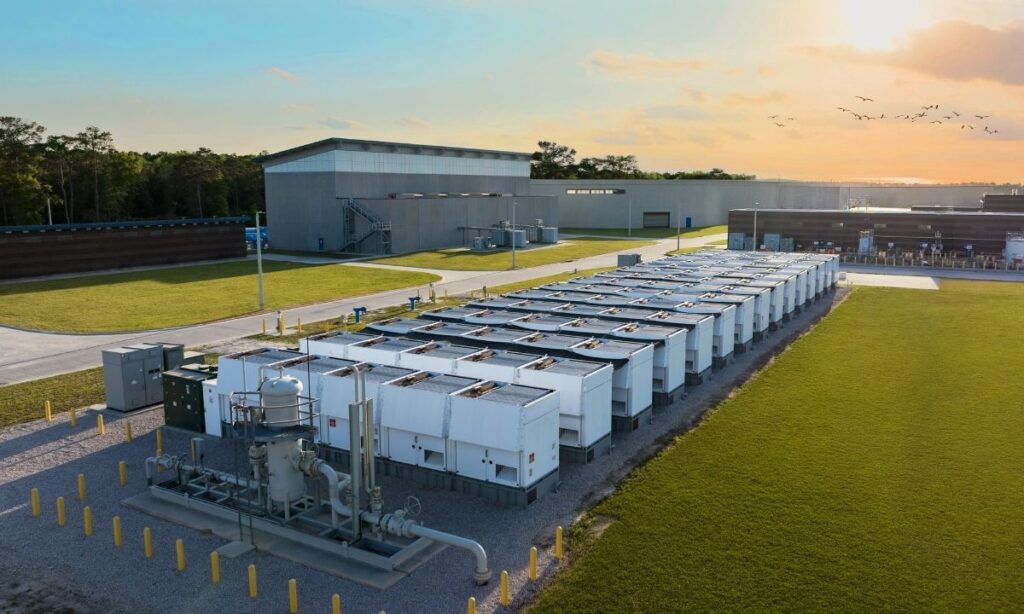

Community resistance to data centers is intensifying. Residents and local officials in states like Indiana, New York and Georgia cite a range of concerns: noise, emissions, water consumption, visual impact, land use and the fear that large new loads will require costly new grid infrastructure — with those costs passed on to ratepayers.
The resulting pushback has triggered moratoriums and legislative pauses leading to delayed permits, higher costs and outright project cancellations. Between 2023 and Q1 2025, an estimated $64 billion in projects were blocked or delayed across the United States. In the second quarter of 2025 alone, that figure jumped to $162 billion.
Faced with mounting opposition, many developers have responded by bringing their own power (BYOP), sourcing onsite generation to supply some or all of their facility’s load rather than relying entirely on the grid. This directly addresses the ratepayer cost concern — a large load that brings its own generation places less pressure on grid infrastructure. However, traditional onsite solutions, such as turbines, can leave community apprehensions around emissions, water consumption, noise and visual impact unresolved.
Flexible, onsite power generation offers policymakers, municipalities and developers a way to capture the economic benefits of data center investment with less conflict and, when paired with pipeline-connected natural gas reciprocating engines, offers a cleaner and more reliable alternative that complements the grid and benefits local communities.
Your Onsite Generation Strategy Can Make or Break Stakeholder Support
Flexible onsite generation is a credible answer to ratepayer cost concerns. Unlike traditional onsite generation, flexible dispatchable assets are designed to serve both the facility and the grid. Because the asset is dispatchable, it can function as a bridge power source before full grid interconnection is established — powering the facility while the project works through the interconnection queue. This allows the facility to operate and generate revenue without waiting years for firm transmission service.
After interconnection, the same asset continues to deliver value to both the facility and the grid. Dispatchable onsite generation can participate in demand response programs, energy markets and ancillary services, in response to real-time grid operator signals. When the grid faces a potential supply shortfall or a delivery constraint, onsite generation ramps up, effectively islanding the facility, which the grid operator sees as a corresponding drop in demand. If the facility has sufficient capacity, the system can transition into a grid asset — exporting power to the broader system and enhancing the grid’s reliability.
When a dispatchable asset participates in energy and capacity markets, it displaces higher-cost resources and lowers system-wide dispatch costs. ERock systems have dispatched in support of the grid more than 200,000 times since 2019.
Natural Gas Reciprocating Engines: A Community-Friendly Power Source
When communities hear “gas generation,” they tend to picture large industrial power plants with 40-foot stacks. In reality, modern reciprocating engine systems are very different from traditional systems. Pipeline-connected natural gas reciprocating engines address community concerns in ways that other generation technologies do not:
The Path Forward
Winning over stakeholders is the defining challenge for data center development right now — and flexible onsite generation is the most direct path forward.
ERock has demonstrated the approach at scale — 1,000 MW installed base, 400+ operational microgrids, high levels of combined reliability, and 38,500+ hours of utility outages covered. For developers facing interconnection queues that stretch years, ERock can typically deploy a 50 MW system in 12–18 months, with 50 MW expansions every six months thereafter.
To learn more about how flexible onsite power can support data center development strategies, contact ERock.